Image













Find information about injuries and illness at school, requirements for giving medicine at school, health screenings, and access health resources.

Our Health Services department supports the health, safety, and well-being of every student so they are ready to learn and succeed. Our school nurses and clinic aides work with students, families, healthcare providers, and school staff to manage health needs, promote wellness, respond to illness and injury, and help students stay healthy and in school.
Every campus has a full-time registered nurse (RN) on-site. The school clinics are equipped to provide basic first aid only. All health services staff are CPR/AED certified and have received emergency preparedness training.
If your child is seriously injured or seriously ill, we will immediately notify you or your authorized emergency contacts.
Certain over-the-counter products are stocked in the clinic for treatment:
Please inform the school nurse if you do not want your child to be treated with these products.
With the appropriate doctor's orders, our nurses can provide procedures such as glucose monitoring, insulin administration, tube feeding, catheterization, tracheostomy care, suctioning, and chest percussion therapy (CPT).
Contact your school nurse for additional information, to schedule a conference and get copies of the appropriate forms for your physician to sign.
Make sure we have the latest health information for your child by completing the form below. You can use the form to make updates throughout the year as needed.
An allergic reaction occurs when the body detects the presence of a substance or food that it deems harmful. In an attempt to protect the body, the immune system produces antibodies and releases chemicals, such as histamine, into the bloodstream. The chemicals released cause many different reactions. An allergic reaction can be mild or severe; it can happen immediately or a few hours after a person has eaten or come in contact with a substance.
Allergies are a growing concern in schools across America. It is a major health issue and must be taken seriously. It is the policy of our school district to make the safety and well-being of students our top priority. Parents can play a vital role in providing the information necessary to make this happen. Your school nurse will create an Individualized Health Care Plan that will include specifics about your student’s reactions, treatment options, and environmental controls.
The Food Allergy Management Team on your campus is available to answer any questions you may have. Please contact your school nurse if needed.
The district’s Food Allergy Management Plan includes Guidelines for the Care of Students with Food Allergies At-Risk for Anaphylaxis, created by the Department of State Health Services.
If your child has a specific food allergy, please contact the school nurse at your child's campus. For more information, see the Special dietary needs page.
If your student has insect allergies that require emergency medical treatment such as epinephrine administration, please contact your school nurse for information including necessary medical forms.
Asthma is the most common chronic childhood disease. Asthma is characterized by excessive sensitivity of the lungs to various stimuli. With asthma, it is very hard to get air in and out of the lungs. Changes in the airways block the flow of air, making it very hard to breathe. Each child reacts differently to the various triggers that may cause asthma symptoms. Asthma cannot be cured, but it can be prevented and controlled. Only in rare cases do children with asthma need emergency care. However, even a mild asthma episode can be frightening.
Some symptoms of asthma are:
Some asthma triggers are:
To control asthma episodes you must treat symptoms early, use medication regularly as prescribed, and know when medical help is needed. Please contact your school nurse for more information.
Diabetes is a lifelong condition, requiring monitoring and judgment in all areas of an individual's life, including exercise, nutrition and illness. Students with diabetes need the support of caring adults to guide them in their disease management to maintain wellness and prevent or delay complications.
HB 984 amends the Health and Safety Code (Chapter 168) to ensure that the students with diabetes obtain appropriate care at school and while participating in any school activity to enhance their health and ensure their safety and optimize academic performance.
If your child needs medication during the school day, please review the requirements below and complete the appropriate form(s).
Students may carry and self-administer approved emergency rescue medication at school and school functions when the required parent, physician, and school nurse permissions are in place.
See information about immunizations, including what's required, how to submit your records and area clinics.
Vision screening is mandated by by Texas law in:
Parents of students who fail two vision screenings will receive a referral letter from the school nurse recommending a more comprehensive exam by an eye doctor.
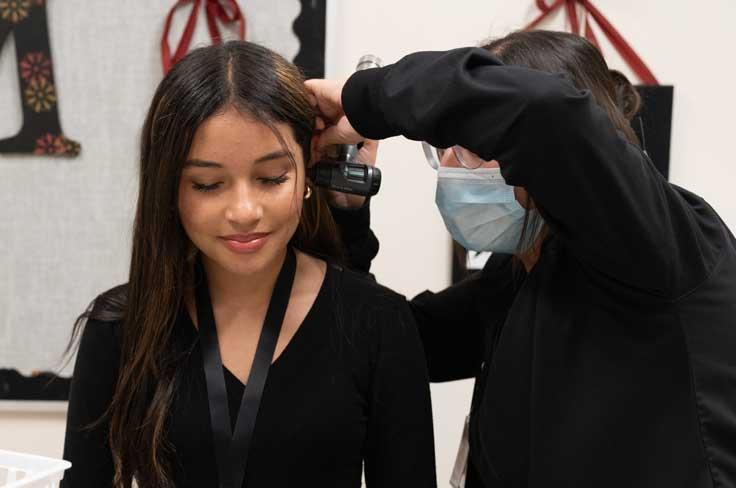
Hearing screening is mandated by Texas law in:
Parents of students who fail two hearing screenings will receive a referral letter from the school nurse or district audiologist recommending a more comprehensive exam by a physician.
Spinal screening is mandated by Texas law for:
Parents of students who have any positive findings will receive a letter from the school nurse with recommendations.
Acanthosis Nigricans (AN) is a skin discoloration that may indicate high levels of insulin in the blood which results from insulin resistance. Insulin resistance can create a potential risk for the development of Type 2 Diabetes. The skin on the nape of the neck will be visually examined.
Acanthosis nigricans screening is mandated by Texas law for:
The screening is usually done at the same time as the vision and hearing screening. If the AN marker is noted, then the student will have blood pressure, height, and weight measured individually and privately at a later date. Parents will be notified of these specific findings.
These health fact sheets are provided by the Centers for Disease Control and Prevention (CDC) and the Texas Department of State Health Services (TDSHS) and do not indicate an outbreak in our area:
Meningitis is an inflammation of the covering of the brain and spinal cord. It can be caused by viruses, parasites, fungi, and bacteria. Viral meningitis is most common and the least serious. Meningitis caused by bacteria is the most likely form of the disease to cause serious, long-term complications. It is an uncommon disease but requires urgent treatment with antibiotics to prevent permanent damage or death.
Bacterial meningitis can be caused by multiple organisms. Two common types are Streptococcus pneumoniae, with over 80 serogroups that can cause illness, and Neisseria meningitidis, with 5 serogroups that most commonly cause meningitis.
Someone with bacterial meningitis will become very ill. The illness may develop over one or two days, but it can also rapidly progress in a matter of hours. Not everyone with meningitis will have the same symptoms.
Children (over 1 year old) and adults with meningitis may have a severe headache, high temperature, vomiting, sensitivity to bright lights, neck stiffness, and drowsiness or confusion. In both children and adults, there may be a rash of tiny, red-purple spots. These can occur anywhere on the body.
The diagnosis of bacterial meningitis is based on a combination of symptoms and laboratory results.
If it is diagnosed early and treated promptly, most people make a complete recovery. If left untreated or treatment is delayed, bacterial meningitis can be fatal, or a person may be left with a permanent disability.
Fortunately, none of the bacteria that cause meningitis are as contagious as diseases like the common cold or the flu, and they are not spread by simply breathing the air where a person with meningitis has been. The germs live naturally in the back of our noses and throats, but they do not live for long outside the body. They are spread when people exchange saliva (such as by kissing; sharing drinking containers, utensils, or cigarettes) or when people cough or sneeze without covering their mouth and nose.
The bacteria do not cause meningitis in most people. Instead, most people become carriers of the bacteria for days, weeks or even months. The bacteria rarely overcome the body's immune system and cause meningitis or another serious illness.
Bacterial meningitis caused by Streptococcus pneumoniae and Neisseria meningitidis may be prevented through vaccination. The vaccine which protects against Streptococcus pneumoniae is called pneumococcal conjugate vaccine or PCV. This vaccine is recommended by the Advisory Council on Immunization Practices (ACIP) for children in the first year of life. Neisseria meningitidis is prevented through two types of vaccines. The first is a meningococcal conjugate vaccine which protects against 4 serogroups A, C, W, and Y and is referred to as MCV4. The second is a vaccine against Neisseria meningitidis serogroup B and is referred to as MenB.
The ACIP recommends MCV4 for children at age 11-12 years, with a booster dose at 16-18 years. In Texas, one dose of MCV4 given at or after age 11 years is required for children in 7th-12th grades. One dose of MCV4 received in the previous five years is required in Texas for those under the age of 22 years and enrolling in college. Teens and young adults (16-23 years of age) may be vaccinated with MenB. This vaccine is not required for school or college enrollment in Texas.
Vaccines to protect against bacterial meningitis are safe and effective. Common side effects include redness and pain at the injection site lasting up to two days. Immunity develops about 1-2 weeks after the vaccines are given and lasts for 5 years to life depending on the vaccine.
Do not share food, drinks, utensils, toothbrushes, or cigarettes. Wash your hands. Limit the number of persons you kiss. Cover your mouth and nose when you sneeze or cough. Maintaining healthy habits, like getting plenty of rest and not having close contact with people who are sick, also helps.
Certain groups are at increased risk for bacterial meningitis caused by Neisseria meningitidis. These risk factors include HIV infection, travel to places where meningococcal disease is common (such as certain countries in Africa and in Saudi Arabia), and college students living in a dormitory. Other risk factors include having a previous viral infection, living in a crowded household, or having an underlying chronic illness.
Children ages 11-15 years have the second highest rate of death from bacterial meningitis caused by Neisseria meningitidis. And children ages 16-23 years also have the second highest rates of disease caused by Neisseria meningitidis.
If you or a friend might have bacterial meningitis seek prompt medical attention. Your school nurse, family doctor, and the staff at your local or regional health department office are excellent sources for information on all infectious diseases. You may call your family doctor or local health department office to ask about meningococcal vaccine. Additional information may also be found at the web sites for the Centers for Disease Control and Prevention (CDC) and the Texas Department of State Health Services (DSHS).